Crescent Utility Cutter Grips
An ergonomic grip redesign shaped by how utility lineman operate their cutters in the field.
What I did:
I led the ergonomic and visual design of the cutter grips, translating field observations into physical prototypes and refining the geometry through hands-on testing with utility lineman.

Role:
Lead Industrial Designer
Team:
Product Management + Engineering
Duration:
4 months // 2024 - 2025
Company:
Apex Tool Group
Status:
Shipped Q3 2025
Crescent Utility Cutter Grips
An ergonomic grip redesign shaped by how utility lineman operate their cutters in the field.
What I did:
I led the ergonomic and visual design of the cutter grips, translating field observations into physical prototypes and refining the geometry through hands-on testing with utility lineman.
Role:
Lead Industrial Designer
Team:
Product Management + Engineering
Duration:
4 months // 2024 - 2025
Company:
Apex Tool Group
Status:
Shipped Q3 2025
// The Problem
Conventional Grips Overlook How Linemen Actually Work
Linemen often operate heavy cutters in confined spaces, using different parts of their bodies for stability and leverage. Conventional grips provide limited support for these working positions.

Existing utility cutter grip designs.
// The Problem
Conventional Grips Overlook How Linemen Actually Work
Linemen often operate heavy cutters in confined spaces, using different parts of their bodies for stability and leverage. Conventional grips provide limited support for these working positions.
Existing utility cutter grip designs.
// The Opportunity
One Grip That Support Lineman's Operating Positions
Design a grip that accommodates seven observed working positions while improving comfort, stability, and control during demanding cuts.

One of the seven operating positions observed in the field.
// The Opportunity
One Grip That Support Lineman's Operating Positions
Design a grip that accommodates seven observed working positions while improving comfort, stability, and control during demanding cuts.
One of the seven operating positions observed in the field.
// The Opportunity
One Grip That Support Lineman's Operating Positions
Design a grip that accommodates seven observed working positions while improving comfort, stability, and control during demanding cuts.
One of the seven operating positions observed in the field.
// The Result
A Grip Designed Around Real Working Behaviors
Through physical prototyping and user testing, I developed a grip with sculpted contact surfaces and targeted textures to support seven operating positions.

// The Result
A Grip Designed Around Real Working Behaviors
Through physical prototyping and user testing, I developed a grip with sculpted contact surfaces and targeted textures to support seven operating positions.
// The Result
A Grip Designed Around Real Working Behaviors
Through physical prototyping and user testing, I developed a grip with sculpted contact surfaces and targeted textures to support seven operating positions.
Shaped for Different Hand and Body Positions
The sculpted geometry provides supporting surfaces for conventional hand grips and body-assisted cutting, helping linemen maintain stability and leverage.

Sculpted support surfaces and grip contours.
Shaped for Different Hand and Body Positions
The sculpted geometry provides supporting surfaces for conventional hand grips and body-assisted cutting, helping linemen maintain stability and leverage.
Sculpted support surfaces and grip contours.
Shaped for Different Hand and Body Positions
The sculpted geometry provides supporting surfaces for conventional hand grips and body-assisted cutting, helping linemen maintain stability and leverage.
Sculpted support surfaces and grip contours.
Textured Where Additional Grip Is Needed
I used observed contact points to guide texture placement, reinforcing key gripping areas while maintaining Crescent's product identity.

Cutter grip and texture details.

Essential label + branding
Textured Where Additional Grip Is Needed
I used observed contact points to guide texture placement, reinforcing key gripping areas while maintaining Crescent's product identity.
Cutter grip and texture details.
Essential label + branding
Textured Where Additional Grip Is Needed
I used observed contact points to guide texture placement, reinforcing key gripping areas while maintaining Crescent's product identity.
Cutter grip and texture details.
Essential label + branding
// The Impact
Lineman Were Surprised How Good The Grips Were
All 10 linemen who evaluated the functional prototypes reported preferring the redesigned grips to cutters they had previously used, providing positive feedback that informed the final design.

Functional prototype testing with linemen.
// The Impact
Lineman Were Surprised How Good The Grips Were
All 10 linemen who evaluated the functional prototypes reported preferring the redesigned grips to cutters they had previously used, providing positive feedback that informed the final design.
Functional prototype testing with linemen.
// The Impact
Lineman Were Surprised How Good The Grips Were
All 10 linemen who evaluated the functional prototypes reported preferring the redesigned grips to cutters they had previously used, providing positive feedback that informed the final design.
Functional prototype testing with linemen.
// Understand Real-World Use
Discovering How Linemen Adapt Their Tools in the Field
I observed utility linemen operating cutters in confined bucket lifts, focusing on how they positioned their bodies, handled the tools, and generated leverage during difficult cuts.

Linemen demonstrated their cutting methods during on-site research.
// Understand Real-World Use
Discovering How Linemen Adapt Their Tools in the Field
I observed utility linemen operating cutters in confined bucket lifts, focusing on how they positioned their bodies, handled the tools, and generated leverage during difficult cuts.
Linemen demonstrated their cutting methods during on-site research.
Identifying Seven Operating Positions Beyond the Standard Grip
I asked linemen to demonstrate their cutting methods and identified seven positions, including shoulder-, chest-, thigh-, and ground-supported use.

Seven operating positions observed in the field.
Identifying Seven Operating Positions Beyond the Standard Grip
I asked linemen to demonstrate their cutting methods and identified seven positions, including shoulder-, chest-, thigh-, and ground-supported use.
Seven operating positions observed in the field.
Identifying Seven Operating Positions Beyond the Standard Grip
I asked linemen to demonstrate their cutting methods and identified seven positions, including shoulder-, chest-, thigh-, and ground-supported use.
Seven operating positions observed in the field.
Finding Critical Contact Points Beyond the Hands
I observed how gloves, body contact, and the cutters' weight affected handling, revealing the need for supporting surfaces beyond conventional hand-grip areas.

Lineman gloves adds new factor to the interaction.
Finding Critical Contact Points Beyond the Hands
I observed how gloves, body contact, and the cutters' weight affected handling, revealing the need for supporting surfaces beyond conventional hand-grip areas.
Lineman gloves adds new factor to the interaction.
Finding Critical Contact Points Beyond the Hands
I observed how gloves, body contact, and the cutters' weight affected handling, revealing the need for supporting surfaces beyond conventional hand-grip areas.
Lineman gloves adds new factor to the interaction.
// Exploring and Refining the Grip
Prototyping Concepts and Test Them
I explored different grip profiles and tested them on functional cutters with real cable samples. This helped reveal handling problems that were difficult to identify through CAD alone. This was done in parallell with other cutters in the same project.

Me sharing how the cutter works for more concrete feedback on my earlier design.
// Exploring and Refining the Grip
Prototyping Concepts and Test Them
I explored different grip profiles and tested them on functional cutters with real cable samples. This helped reveal handling problems that were difficult to identify through CAD alone. This was done in parallell with other cutters in the same project.
Me sharing how the cutter works for more concrete feedback on my earlier design.
Exploring Grip Geometry for Multiple Contact Points
I developed alternative profiles to investigate how curves, flared ends, and supporting surfaces could accommodate seven operating positions without excessive bulk.
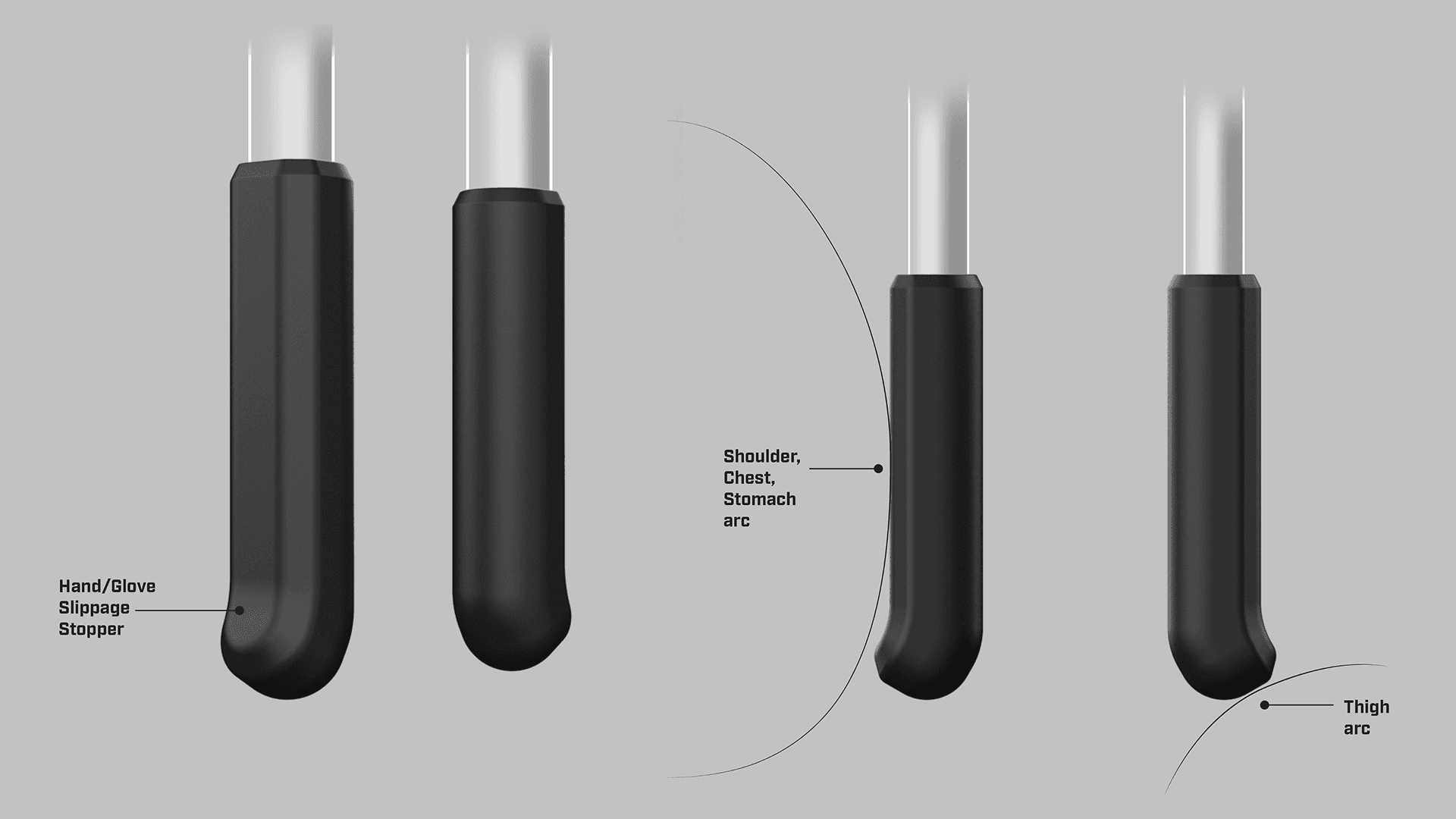
Early forms explored stabilizing features and body-contact curves. (Concept 1)
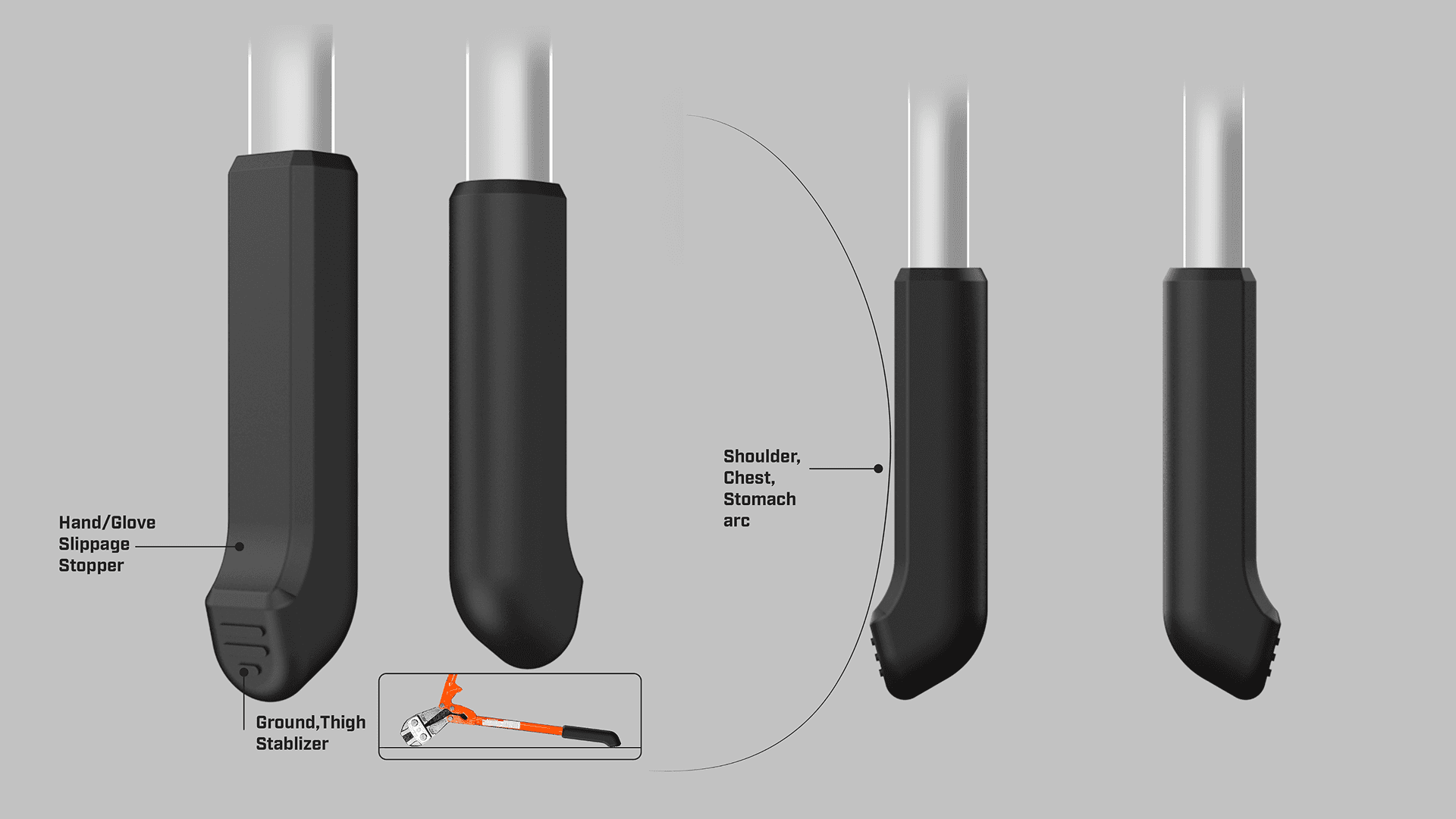
Early forms explored stabilizing features and body-contact curves. (Concept 2)

Early forms explored stabilizing features and body-contact curves. (Concept 3)
Exploring Grip Geometry for Multiple Contact Points
I developed alternative profiles to investigate how curves, flared ends, and supporting surfaces could accommodate seven operating positions without excessive bulk.
Early forms explored stabilizing features and body-contact curves. (Concept 1)
Early forms explored stabilizing features and body-contact curves. (Concept 2)
Early forms explored stabilizing features and body-contact curves. (Concept 3)
Testing Prototypes Under Real Cutting ConditionsPressure
I fitted 3D-printed grips onto working cutters and tested them with cable samples to evaluate leverage, comfort, and stability under realistic loads.

3D-printed mockups were fitted onto cutter handles to evaluate their proportions.

Testing with real cables helped reveal the physical demands of cutting.
Testing Prototypes Under Real Cutting ConditionsPressure
I fitted 3D-printed grips onto working cutters and tested them with cable samples to evaluate leverage, comfort, and stability under realistic loads.
3D-printed mockups were fitted onto cutter handles to evaluate their proportions.
Testing with real cables helped reveal the physical demands of cutting.
Learning From Slipping, Pressure Points, and Limited Leverage
Testing revealed that some profiles lacked support for applying force, slipped under the tool's weight, or created uncomfortable contact points. I refined the curves and supporting surfaces to address these weaknesses.

Problems identified during prototype testing.

Grip geometry refinements.

Iterative physical prototypes.
Learning From Slipping, Pressure Points, and Limited Leverage
Testing revealed that some profiles lacked support for applying force, slipped under the tool's weight, or created uncomfortable contact points. I refined the curves and supporting surfaces to address these weaknesses.
Problems identified during prototype testing.
Grip geometry refinements.
Iterative physical prototypes.
// Validating With Users
Bringing Refined Prototypes Back to the Linemen
I developed functional prototypes around the seven operating positions and evaluated them with project stakeholders and utility linemen to understand how well the geometry supported real cutting behaviors.

Functional prototypes used for evaluation.
// Validating With Users
Bringing Refined Prototypes Back to the Linemen
I developed functional prototypes around the seven operating positions and evaluated them with project stakeholders and utility linemen to understand how well the geometry supported real cutting behaviors.
Functional prototypes used for evaluation.
Confirming the Direction and Finding What to Refine
I evaluated the prototypes with Product Management, Engineering, and other project stakeholders before returning to the field for hands-on testing with linemen. Their feedback helped identify further refinements to the grip shape and contact surfaces.

Cross-functional team evaluations.

Utility lineman evaluation.
Confirming the Direction and Finding What to Refine
I evaluated the prototypes with Product Management, Engineering, and other project stakeholders before returning to the field for hands-on testing with linemen. Their feedback helped identify further refinements to the grip shape and contact surfaces.
Cross-functional team evaluations.
Utility lineman evaluation.
Mapping Real Contact Points to Guide Texture Placement
I mapped where linemen held and braced the cutters during testing, using those contact areas to prioritize texture placement on each grip.

Identified contact-point mapping.

Crescent branding elements

Final detailing to the grip.
Mapping Real Contact Points to Guide Texture Placement
I mapped where linemen held and braced the cutters during testing, using those contact areas to prioritize texture placement on each grip.
Identified contact-point mapping.
Crescent branding elements
Final detailing to the grip.
Mapping Real Contact Points to Guide Texture Placement
I mapped where linemen held and braced the cutters during testing, using those contact areas to prioritize texture placement on each grip.
Identified contact-point mapping.
Crescent branding elements
Final detailing to the grip.
Communication Under Pressure
Live events move quickly. Coordinators must make time-sensitive decisions, respond to unexpected changes, and keep multiple people aligned - often while juggling different communication tools in noisy environments.

Refined grip prototype iterations.

Refined functional grip prototypes.
Communication Under Pressure
Live events move quickly. Coordinators must make time-sensitive decisions, respond to unexpected changes, and keep multiple people aligned - often while juggling different communication tools in noisy environments.
Refined grip prototype iterations.
Refined functional grip prototypes.
// The Reflection
Real-World Observation Reveals What Design Briefs Can Misssed
This project reinforced the value of observing people in their working environment and testing ideas with functional prototypes. The seven operating positions and subsequent refinements emerged from understanding how linemen actually use their tools.

Final grip design for production.ere
// The Reflection
Real-World Observation Reveals What Design Briefs Can Misssed
This project reinforced the value of observing people in their working environment and testing ideas with functional prototypes. The seven operating positions and subsequent refinements emerged from understanding how linemen actually use their tools.
Final grip design for production.ere